

Youth Charter National Call 2 Action Response
- Dec 4, 2025
- 4 min read
A National Youth Development Investment Framework for a Generation in Crisis
Introduction: A National Call 2 Action for Our Young People
The Youth Charter (YC) welcomes the renewed public, political and policy focus on young people across the UK. However, the scale and fragmentation of current initiatives reveal a persistent structural problem: there is still no coherent, coordinated, cross-government National Youth Development Strategy with the investment required to meet the urgent needs of young people.
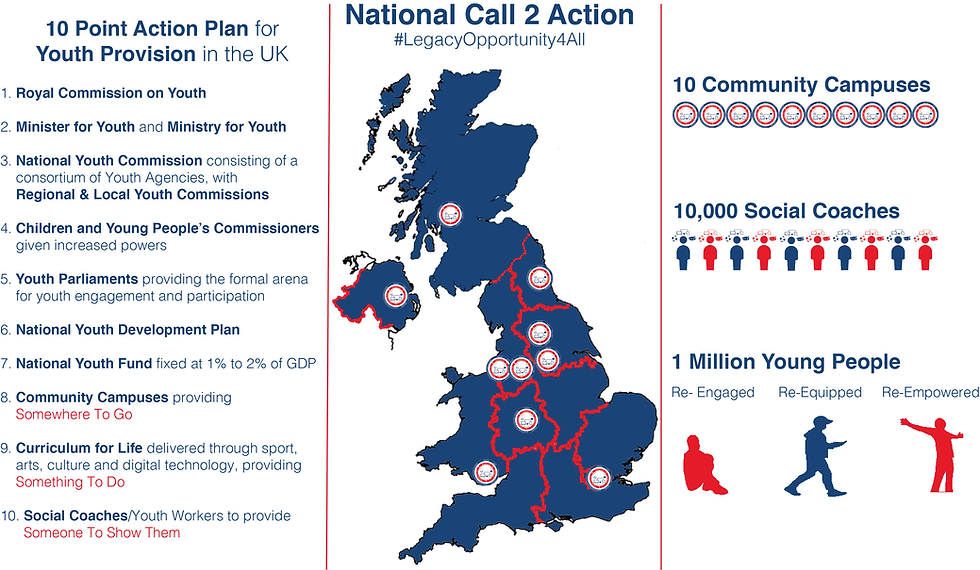
The Youth Charter’s National Call 2 Action has, since 1993, championed a simple, universal principle:
A National Youth Fund equal to 1–2% of GDP,
As part of 10% GDP investment in education across the life course,
Delivered through a National Youth Development Plan,
Anchored by the Community Campus Model and Legacy Cultural Framework.
This remains the only fully costed, place-based, cross-sector proposal on the table.
The newly published youth policy landscape reinforces, not replaces, the necessity of such a structural plan.
The Current Landscape: Progress, but Fragmented and Insufficient
Across government departments, numerous initiatives have emerged:
National Youth Strategy (DCMS) – strong on youth voice and consultation, unclear on sustained long-term funding.
Youth Guarantee (DWP) – a necessary employment intervention but targeted only at 18–21-year-olds after 18 months of inactivity.
Young Futures Hubs (DfE & Home Office) – promising integrated hubs but currently limited to 8 areas with an aspiration of 50 over four years.
Enrichment Framework (DfE) – welcome recognition of arts and culture but focused exclusively on schools.
Dormant Assets Fund (£132.5m for youth) – helpful but insufficient for nationwide coverage.
Local Growth & Neighbourhood Funds – long-term regeneration but without an integrated youth component.
Better Futures Fund (£500m) – important but dispersed across multiple sectors.
Turnaround Programme (MoJ) – critical for early intervention but targeted only at those on the cusp of offending.
The combined scale of these initiatives, while significant, does not constitute a coordinated national youth development system.
There is no single framework that brings together:
Places (communities, neighbourhoods, local assets)
People (youth workers, teachers, coaches, volunteers)
Programmes (sport, arts, culture, digital, mentoring)
Pathways (education, employment, identity, leadership)
A holistic National Youth Development Investment Plan remains absent.
The Case for a National Youth Development Investment Fund
The evidence is clear:
Almost 1 million young people are NEET.
£132.5m isolated in youth funds is not enough.
Economic modelling now shows £2.40 return for every £1 invested in youth services, with long-term gains in earnings, reduced crime, increased productivity and improved wellbeing.
Stable youth provision cannot rely on short-term pilots or competitive bidding rounds.
National Youth Development Fund (1–2% of GDP) to support:
a. Youth Development Services (Revenue)
Universal and targeted youth work
Social Coach workforce
Mental health and wellbeing support
Pathways into education, skills and employment
b. Youth Development Infrastructure (Capital)
• Community Campus upgrades
• Youth centres and shared cultural/sporting spaces
• Digital access hubs
• Safe, inclusive neighbourhood facilities
c. Cross-Sector Alignment (Governance)
DCMS (youth, culture), DfE (education), DWP (employment), MoJ (justice), DHSC (health)
Local authorities and Mayoral combined authorities
Civil society partnerships
School, college and community networks
This is the “missing centrepiece” in current Government and Opposition proposals.
The Community Campus Model

The YC Community Campus Model is the only fully developed, place-based framework capable of uniting fragmented national and local initiatives.
It provides:
a. Place-Based Delivery (“Somewhere to Go”)
Existing school, community, faith, leisure, sport and cultural assets activated as youth campuses.
Scalable in every ward, neighbourhood and local authority.
b. Programme-Based Engagement (“Something to Do”)

Youth Charter’s 25-year evidence base of programmes:
- Sportwise
- Artwise
- Culturewise
- Digitalwise
- Lifewise
- Social Coach training
c. People-Based Empowerment (“Someone to Talk To”)
Social Coaches, teachers, mentors, youth workers, community volunteers, artists, athletes and cultural leaders.
A system for 10,000 trained adults in each region, as per the Centre for Young Lives recommendations.

d. Pathways to Potential
School engagement and attendance
Skills development and employment
Positive identity formation
Gender equality and SEND inclusion
Violence reduction and safer communities
This maps directly onto:

The Youth Strategy
The Young Futures Hubs
The DWP Youth Guarantee
The Enrichment Framework
The Better Futures Fund
The Dormant Assets Youth Allocation
YC provides the integration, the continuity, and the framework that government policy currently lacks.
Youth Charter National Call 2 Action
YC issues the following updated National Call 2 Action, based on the current policy landscape:
a. Establish a National Youth Development Investment Fund
Set at 1–2% of GDP, combining revenue and capital investment.
b. Adopt the Youth Charter Community Campus Model as the National Delivery Framework
Using existing assets, local partnerships and Social Coach development.
c. Implement a National Social Coach Workforce Programme
Training 100,000 Social Coaches over 5 years.
d. Co-locate Government Youth Initiatives in Community Campuses
Including Young Futures Hubs, VRUs, Youth Guarantee Trailblazers, Youth Offending Teams, and Enrichment Framework partners.
e. Prioritise the 75 “Left Behind Neighbourhoods” and 25 Trailblazer Areas
Community Campuses provide immediate activation without major capital spend.
f. Embed Arts, Culture, Sport, Digital and Wellbeing as Core Youth Development Pillars
Not optional add-ons.
g. Deliver a National Youth Summit and Youth Leadership Forum in 2026
To co-produce the Youth Plan with young people across the UK.
Conclusion: A National Framework, Ready to Deploy Now
The Youth Charter stands ready to support national and local government, civil society, education, sport and cultural partners in delivering:
A safe, supported generation
A coherent and coordinated system
A future workforce and skills pipeline
Stronger communities and better life chances
A measurable social and economic return
The YC’s National Call 2 Action is clear:
Britain cannot afford another generation lost to disinvestment, fragmentation and crisis.
The Youth Charter provides the national framework capable of turning policy ambition into sustainable impact for every young person, in every neighbourhood, across the UK.


Comments