

From Roadshows to Results: Why Britain Needs a National Youth Taskforce Now…

This week’s headlines should serve as a national wake-up call.

New figures show that 957,000 young people aged 16–24 are not in education, employment or training (NEET).
Perilously close to one million for the first time in over a decade. At the same time, police across London are bracing for so-called “TikTok school wars”, where online provocation spills into real-world violence among children barely into their teenage years.
These are not disconnected stories. They are symptoms of the same national failure: a fragmented youth ecosystem that lacks coordination, continuity and leadership. Britain does not suffer from a shortage of youth initiatives. We suffer from a shortage of integration.

The Government’s developing National Youth Strategy is a welcome step. But if it is to succeed, it must now move beyond consultation roadshows and listening exercises toward delivery architecture. We need a National Youth Taskforce — mandated, resourced and accountable — to convert strategy into sustained action.
The Scale of the Challenge
The Office for National Statistics data confirms that youth unemployment stands above 16 per cent — more than three times the general rate. Nearly one million young people are disconnected from structured pathways to work, education or training. At the same time:
Schools are reporting rising safeguarding concerns linked to social media mobilisation.
Police forces are diverting resources to manage digitally coordinated disorder.
Mental health referrals for young people continue to increase.
Employers report a widening skills and work-readiness gap.
We are witnessing a convergence of economic inactivity, digital volatility and community fragmentation. Roadshows will not solve that.
A Local Issue Demanding a National Response
Youth violence, digital manipulation and economic inactivity manifest locally — in boroughs, estates, schools and town centres. But the drivers are national: labour market policy, digital regulation, education reform, funding fragmentation and the absence of coordinated early intervention.

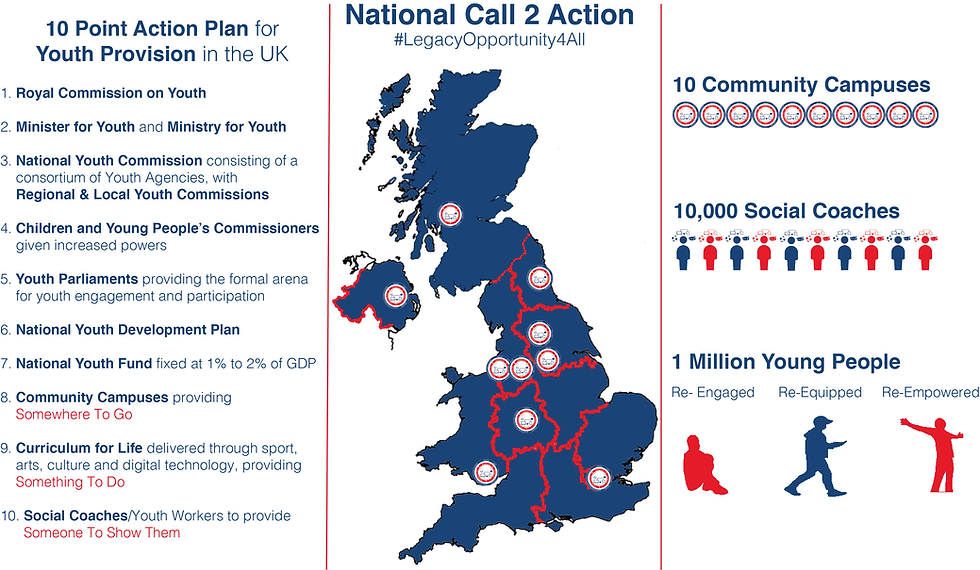
This is precisely why the Youth Charter has long advocated for its Community Campus Model — a cohesive, place-based framework integrating sport, culture, arts, education, mentoring, employability and social enterprise within a single delivery architecture. The Community Campus is not another programme. It is infrastructure.
It brings together:
Schools and colleges
Police and community safety partnerships
Local authorities
Health and wellbeing services
Employers and apprenticeship providers
Social Coaches trained in prevention and early intervention
Under one coordinated framework with measurable outcomes aligned to the UN Sustainable Development Goals and national youth policy objectives.
From Fragmentation to Integration
For too long, youth engagement has been episodic:
A summer diversion scheme
A one-year funding pot
A digital literacy campaign
A consultation tour
Each worthwhile in isolation. Insufficient in aggregate. The “school wars” phenomenon demonstrates the speed at which digital narratives can mobilise young people — faster than traditional institutions can respond. If a social media post can mobilise hundreds within hours, government must be able to mobilise prevention and engagement infrastructure with equal speed and coordination.
That requires:
A National Youth Taskforce reporting across departments — Education, Home Office, DCMS, Work and Pensions, Health and Treasury
A unified data and impact framework linking NEET reduction, violence prevention and mental wellbeing
Mandated local delivery hubs — Community Campuses — serving as operational arms of national strategy
Long-term funding cycles (5–10 years), not annual grants
A trained Social Coach workforce embedded in communities
Moving Beyond the Youth Guarantee
The Government’s Youth Guarantee and apprenticeship expansion are necessary — but they operate largely at the point of economic intervention.
The crisis begins earlier.
Disengagement from school.
Digital alienation.
Loss of purpose.
Community breakdown.
By the time a young person becomes NEET, we are already responding late. The Community Campus model intervenes upstream:
Sport and cultural engagement to build belonging
Mentoring and character education to build resilience
Digital literacy to counter harmful online mobilisation
Skills and enterprise pathways to connect aspiration with opportunity
Engage. Equip. Empower. This is not rhetoric. It is a structured prevention pathway.
Leadership in a Critical Week
The position of nearly one million NEET young people and the rise of digitally coordinated “school wars” should not be seen as coincidence. Economic inactivity breeds frustration.
Digital ecosystems amplify grievance. Lack of local infrastructure leaves a vacuum. That vacuum will be filled — by either positive engagement or destructive mobilisation.
Government leadership now means moving from listening to legislating; from consulting to coordinating; from roadshows to results. A National Youth Taskforce, working in partnership with organisations such as the Youth Charter and local authorities, could:
Map national risk hotspots
Deploy integrated prevention team
Align funding streams
Scale proven Community Campus sites
Track real-time youth engagement and employment metrics
Britain has hosted Olympic Games, Commonwealth Games and global summits. We know how to mobilise cross-sector effort when we choose to. The youth crisis demands the same urgency. Nearly one million young people disconnected from opportunity is not a statistic. It is a structural warning. The choice before us is clear- Continue with fragmented interventions and rising volatility- Or build a coordinated, accountable, nationally mandated youth engagement system.
The Youth Charter’s Call to Action is simple: establish a National Youth Taskforce and scale Community Campus delivery as the operational backbone of the UK’s National Youth Strategy. Local delivery, national coordination. Long-term investment and commitment.
In a week defined by troubling headlines, this is the moment for government to lead — decisively, cohesively and with the scale the challenge demands. The future of a generation cannot be managed through roadshows. It must be built through strategy, structure and sustained national resolve.


Comments