

Oxford Debates the Future of Youth While the Streets Burn...


As delegates from across the Commonwealth gather this week at University of Oxford for a Commonwealth Youth Summit, the speeches will be inspiring, the language ambitious, and the intentions no doubt sincere.
For three days, young leaders representing nations that together make up 2.5 billion people will debate the future of youth opportunity, leadership, and development across the Commonwealth.
But while the conversations take place inside Oxford’s historic halls, a far more urgent conversation is unfolding outside them on the streets of Britain and the contrast could not be starker.
Across the Easter weekend, communities once again witnessed rising youth violence, antisocial behaviour, and the tragic loss of young lives. Businesses and civic leaders, including major retailers such as Marks & Spencer, openly questioned the government about what is being done to address the growing crisis affecting Britain’s town centres and neighbourhoods.
The government response was the use of more surveillance technology, more policing tools and a promise to build a handful of new youth clubs.
As part of this strategy, ministers have highlighted investment in knife-crime hotspot mapping technology and expanded facial recognition capability to identify offenders in areas experiencing high levels of violence.
However, while government policy focuses on tracking young people, it continues to neglect the deeper question: Who is actually investing in them?
At the very moment the Commonwealth gathers in Oxford to discuss youth opportunity, the United Kingdom itself is struggling to provide the social infrastructure needed to support young people at home. This is not just a national issue; it is a Commonwealth challenge.
Across the Commonwealth, communities are confronting the same pressures:
youth unemployment
rising inequality
social fragmentation
declining community infrastructure
and increasing youth violence
Yet the Commonwealth has something uniquely powerful at its disposal: sport, culture and youth leadership as tools of social transformation.
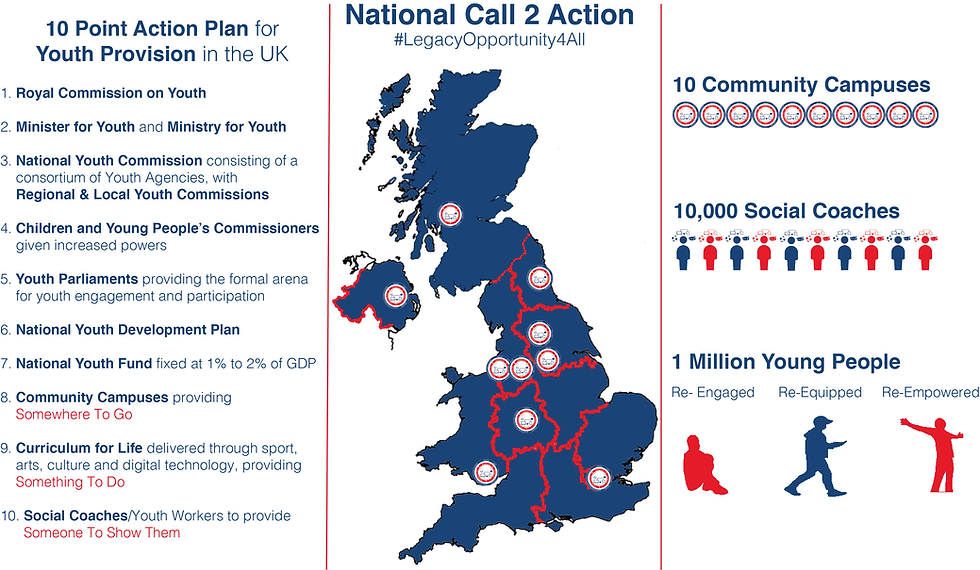
That potential could be realised through a practical framework already developed over three decades by the Youth Charter the Global Community Campus movement.
In just over a year, the Commonwealth will once again turn its attention to the United Kingdom as 2026 Commonwealth Games preparations gather momentum in Glasgow.
We know that major sporting events always promise legacy. But too often that promise has meant stadiums, infrastructure and international spectacle rather than lasting investment in the young people whose futures those events claim to celebrate.
Glasgow 2026 represents a chance to do something different. It could become the catalyst for a Commonwealth-wide youth legacy programme, linking communities through a network of Community Campuses built on the principles of Sport for Development and Peace.
Such campuses would not simply provide facilities. They would create ecosystems of opportunity:
trained Social Coaches engaging, equipping and empowering young people
sport and cultural programmes developing leadership and wellbeing
pathways into education, employment and entrepreneurship
local communities connected to a global Commonwealth youth network
From neighbourhood streets to international collaboration, this would represent the type of legacy the Commonwealth was created to deliver.
Instead of structural change, Britain’s current youth strategy appears fragmented and reactive. Youth violence spikes, government announces new initiatives, surveillance technology is expanded and the cycle repeats.
In addition to this, the ambition to reduce knife crime by 50% reveals a troubling lack of ambition. Why not eradicate it? Young people are not statistics. They are sons, daughters, brothers and sisters whose futures should not be reduced to percentages.
There is a serious lack of coherent youth policy architecture. Youth clubs alone will not solve this crisis, policing alone will not solve this crisis, technology alone will certainly not solve this crisis.
The issue is not simply crime. Young people are disconnected from opportunity, communities are disconnected from investment, governments are disconnected from the realities of life on the streets.
The Youth Charter’s Call to Action
For over thirty years the Youth Charter has argued that the real solution lies in building community-based youth ecosystems. The Community Campus Model provides exactly that.

It integrates:
• sport
• arts and culture
• education and training
• mentorship and social coaching
• digital youth engagement
It moves beyond short-term interventions toward long-term prevention, intervention and rehabilitation and crucially, it creates a framework capable of operating locally, nationally and internationally.
The gathering at Oxford and the approaching Glasgow 2026 Games represent more than events in a calendar. They represent a test of political will.
We ask the question; will leaders continue to react to youth crises after they occur or will they invest in the social infrastructure capable of preventing them in the first place?

The Commonwealth Youth Summit could become a turning point the moment the Commonwealth commits to a global youth movement grounded in Sport for Development and Peace or it could become another missed opportunity.
While policymakers debate policy frameworks, young people are waiting for something far more basic: Hope and opportunity.
The Youth Charter believes the answer is within reach. A Commonwealth network of Community Campuses could transform the lives of millions of young people across the world. However, transformation does not begin in conference halls it begins on the streets.
If we want safer streets tomorrow,
we must invest in young lives today.



Comments