

When the Average Victim Is 14: Why Britain Must Rethink Youth Policy...

Every generation reaches a moment when the evidence becomes too stark to ignore. The latest analysis of youth knife deaths in England should be one of those moments.
The research shows that the average age of a child fatally stabbed is now just 14 years old. Nearly all the victims are boys. Many are known to social services. Many have experienced domestic violence, trauma or the loss of a key adult figure in their lives. And the inequalities are staggering: young people of Black ethnicity are 13 times more likely to die from knife injuries, while those growing up in the most deprived communities are seven times more likely to lose their lives to violence.
Behind these numbers are children whose lives ended before they had the chance to become anything at all. Yet the real tragedy is that none of this is new.
For more than three decades working in communities across Britain and internationally through the Youth Charter, I have seen the same patterns repeat themselves: young people growing up without opportunity, without positive pathways, and too often without the support structures that allow them to thrive. When young people fall through the cracks of society, they do not fall into nothing. They fall into the streets. And the streets are rarely forgiving.
Violence Is a Symptom, Not the Cause…
Too often the national conversation about knife crime focuses on policing, sentencing and enforcement. These measures are necessary. But they are not sufficient. Youth violence is the visible symptom of deeper structural challenges: poverty, trauma, inequality, exclusion and the absence of meaningful opportunity. The report reveals that three quarters of the young victims were already known to social services.
In other words, the system had already encountered these children. But somewhere along the way, the intervention that might have changed their path never arrived. The uncomfortable truth is that Britain does not lack youth policies. What it lacks is a coherent youth system.
Responsibility for young people is scattered across government departments - education, justice, health, employment, culture - each working within its own framework, age definitions and priorities. The result is a fragmented approach that struggles to respond to the complex realities young people face today. Young people do not live their lives in government silos. Yet that is how policy is often designed.
The Missing National Conversation…
The United Kingdom has ministries for defence, transport, business and energy. But when it comes to young people-the very future of our society-there is no single minister responsible for ensuring that youth policy works as a joined-up national system. This absence of leadership has real consequences. It means youth services are often treated as discretionary rather than essential. It means prevention struggles to compete with crisis response. And it means that when tragedies occur, the response is often reactive rather than strategic. What Britain needs now is a national conversation about youth that goes beyond crisis headlines.

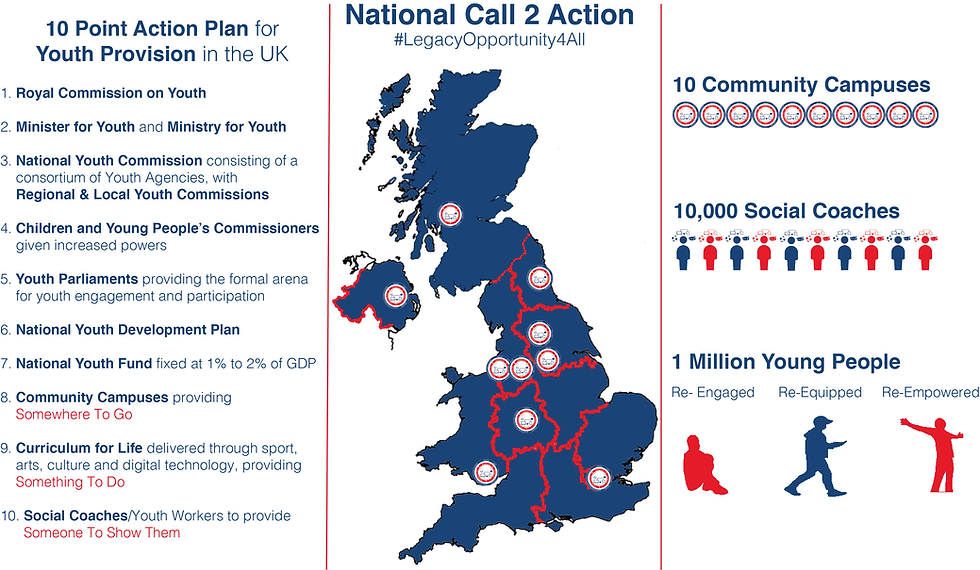
The Youth Charter has long argued that the time has come to rethink how this country governs youth policy. Three steps could begin that transformation. First, the creation of a Minister for Youth, responsible for coordinating youth policy across government.
Second, the establishment of a Royal Commission on Youth to undertake a long-term, independent review of youth development, opportunity and social mobility in Britain.
Third, the creation of a National Youth Commission to monitor youth outcomes and ensure that young people themselves have a voice in shaping the policies that affect their lives.
These are not bureaucratic proposals. They are about recognising that the challenges facing young people today—from violence to mental health to digital influence—are too complex to be addressed piecemeal.
The Power of Prevention
One of the most important lessons from decades of youth work is that prevention works. Sport, culture and the arts have repeatedly proven their ability to engage young people who might otherwise feel disconnected from mainstream society. On a football pitch, in a community arts programme, or through youth leadership initiatives, young people find something many have never been offered before: belonging.

At the Youth Charter we call this the Community Campus Model - creating safe spaces where young people can engage, develop skills and build confidence through sport, culture and education. These programmes do not just change behaviour. They change life trajectories.
A Choice for the Next Generation…
The figures in the new report should not simply shock us. They should challenge us. Because a society is ultimately judged by how it treats its young people.
If we continue to treat youth violence purely as a criminal justice issue, we will remain trapped in a cycle of reaction and tragedy.
But if we recognise it as a symptom of deeper social conditions - and respond with the leadership, investment and vision that young people deserve - we can begin to build a different future. A future where the average age of a victim is no longer 14. And where the streets are no longer the place where too many young lives are lost. The question is not whether Britain can afford to rethink youth policy.
The question is whether we can afford not to.


Comments