

Dunblane 30 Years On: From Tragedy to Hope - Why Sport for Development Is Needed on the Streets of Britain...
- Mar 13
- 4 min read

Thirty years ago, the nation stood still as the tragedy at Dunblane Primary School shocked the United Kingdom and the world. The loss of sixteen children and their teacher remain one of the darkest moments in modern British history. The campaign that followed, symbolised by the “tear drop” movement, helped bring about one of the strongest gun control frameworks in the world and demonstrated the power of collective civic action.
Today, however, while that campaign transformed legislation, the deeper challenge of youth violence continues to affect communities across the UK. As the Youth Charter approaches its 33rd year working on the streets with young people, the anniversary of Dunblane is not only a moment of remembrance; it is also a moment for reflection and renewed action.
From Dunblane Survivors to Global Champions
Among the children present at Dunblane that day were Andy Murray and his brother Jamie Murray.
What followed in the years after that tragedy stands as one of the most powerful examples of how sport can transform lives.

Through tennis, the Murray brothers built careers that would see them become world champions, Olympic gold medallists, and global ambassadors for British sport. Yet their impact extends far beyond sporting success. Their work supporting humanitarian causes, children’s charities, and community initiatives reflects how sport can become a pathway for resilience, healing, and social contribution.

The story of Andy and Jamie Murray is therefore not simply a sporting success story. It is a Sport for Development and Peace story. It demonstrates how opportunity, mentoring, coaching, and positive environments can redirect lives away from trauma and towards achievement and service.
The Lesson for Britain’s Streets Today
Thirty years after Dunblane, young people across the UK face different but equally urgent challenges.
In recent days alone, the country has witnessed a number of deeply troubling incidents involving young people:
A boy appearing in court after a 15-year-old boy was stabbed at a school in Nottingham
A boy charged following the stabbing of a teenage girl at a school in Norwich
A teenage girl has been left 'too traumatised for shool' after being stabbed in Bristol
A teenager girl shot was shot in the legs in a 'targeted shooting' in Liverpool
These incidents are not isolated tragedies. They are part of a growing pattern of youth violence affecting schools, communities and neighbourhoods across the country.
Across many towns and cities:
Young lives are still being lost to violence.
Communities are struggling with gang influence and weapon carrying.
Schools and neighbourhoods are confronting growing tensions among young people.

While knives have been the focus of many public debates, firearms and other weapons remain part of the wider culture of violence affecting some communities. As the Youth Charter has previously argued, the time has come to move beyond fragmented responses and toward a national “Weapons Off Our Streets” movement.
Such an approach must combine legislation, education, prevention, and community engagement.
But most importantly, it must provide positive alternatives for young people.
The Power of Sport for Development and Peace

The Youth Charter was founded on the belief that sport, art, culture, and digital engagement can be powerful tools for social transformation.
Through programmes such as:

Community Campus initiatives
Youthwise street-to-sport engagement pathways
Young people are given opportunities to:
build confidence and discipline
develop leadership skills
form positive peer networks
connect with mentors and role models
The journey of Andy and Jamie Murray illustrates exactly why such pathways matter.
Without access to structured sporting environments, coaching support, and community encouragement, the talents of many young people remain undiscovered and unrealised.
Sport provides not only competition but identity, belonging, and purpose.
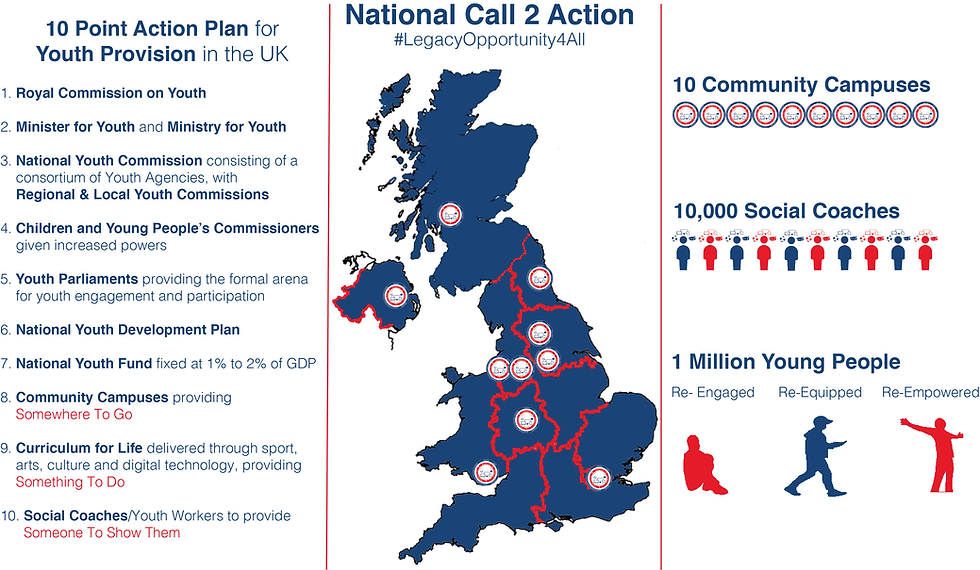
On this 30th anniversary of Dunblane, the Youth Charter calls for a renewed national effort to address youth violence and social fragmentation.
We propose three key actions:
Safe Streets Amnesty
A national amnesty encouraging the removal of weapons from our streets and communities.
The expansion of Youth Charter Community Campuses across UK cities to provide safe spaces where young people can engage in sport, arts, culture, and mentoring.
A national programme of Social Coaches trained to work directly with young people most at risk of exclusion and violence.
From Tears to Transformation
The “tear drop” symbol that emerged from Dunblane represents both grief and determination. It reminds us that tragedy can lead to change when communities act together.
Thirty years on, the example of Andy and Jamie Murray shows what is possible when young people are supported, guided, and given opportunities to thrive.
Their journey from survivors of tragedy to global champions embodies the very principle that underpins the Youth Charter’s mission:
‘Sport can transform lives’
The challenge for Britain today is to ensure that every young person growing up on our streets has access to that same opportunity.
Because the greatest legacy we can honour from Dunblane is not only remembrance.
It is action that ensures safer streets, stronger communities, and hopeful futures for the next generation.


Comments