

A Tribute to Arthur Ashe: 54 Years On...

"From what we get, we can make a living;
what we give, however, makes a life."
Arthur Ashe

On Friday, Ben Shelton and Frances Tiafoe will walk onto Arthur Ashe Stadium and guarantee something American tennis has not seen in more than half a century: a Black American man in the US Open men's final. Whoever wins will do so 54 years after Arthur Ashe himself last reached that final, in 1972 and 58 years after Ashe became the first man to win the US Open in the Open Era, in 1968.

The timing carries its own weight. This week marks the exact anniversary of that breakthrough: on September 9, 1968, Arthur Ashe lifted the US Open trophy as the first Black man to do so, a result that still reads as one of the most significant days in the history of American sport. Fifty-eight years later, almost to the day, tennis is once again being asked what it has done with the door he forced open.

The Youth Charter's Tenniswise programme exists because of what Arthur Ashe represented, on and off the court. Ashe was never only a champion - he was a barrier-breaker in a sport that had offered people who looked like him almost no path in, an advocate who used his platform to confront apartheid and inequality long before it was comfortable to do so, and a believer, right up until his death in 1993, that sport carried a responsibility far beyond the scoreline.

That belief is the foundation Tenniswise stands on: sport as a vehicle for education, discipline, health, self-belief and opportunity, delivered to young people regardless of their background, postcode or the ability of their family to pay for lessons and equipment.
Fifty-four years is too long. It should not have taken this long for another Black American man to stand where Ashe once stood. That gap is itself a reminder of how much work remains in access to coaching, to facilities, to competitive pathways, and to the belief that tennis is a sport for everyone, not a sport for the few who can already afford it.

That is precisely the gap Tenniswise is built to close. Through the Youth Charter's wider Community Campus Model, Tenniswise brings court time, coaching and mentoring to young people in communities that the traditional tennis pathway has too often overlooked using the same principles of Engage, Equip and Empower that have guided the Youth Charter's work for over three decades.
Britain's own version of that gap runs just as deep, and its roots reach back further than most people realise. In the years following the social unrest in Brixton in the early-to-mid 1980s, a generation of grassroots coaches and community organisers looked at Ashe's example - a Black champion who had used tennis to build discipline, opportunity and pride in communities the sport had ignored and tried to plant the same idea in south London and other inner cities, at a time when a young Black player picking up a racket was still treated as the exception rather than the rule. That work was slow, underfunded, and largely invisible to the tennis establishment, but it never stopped.
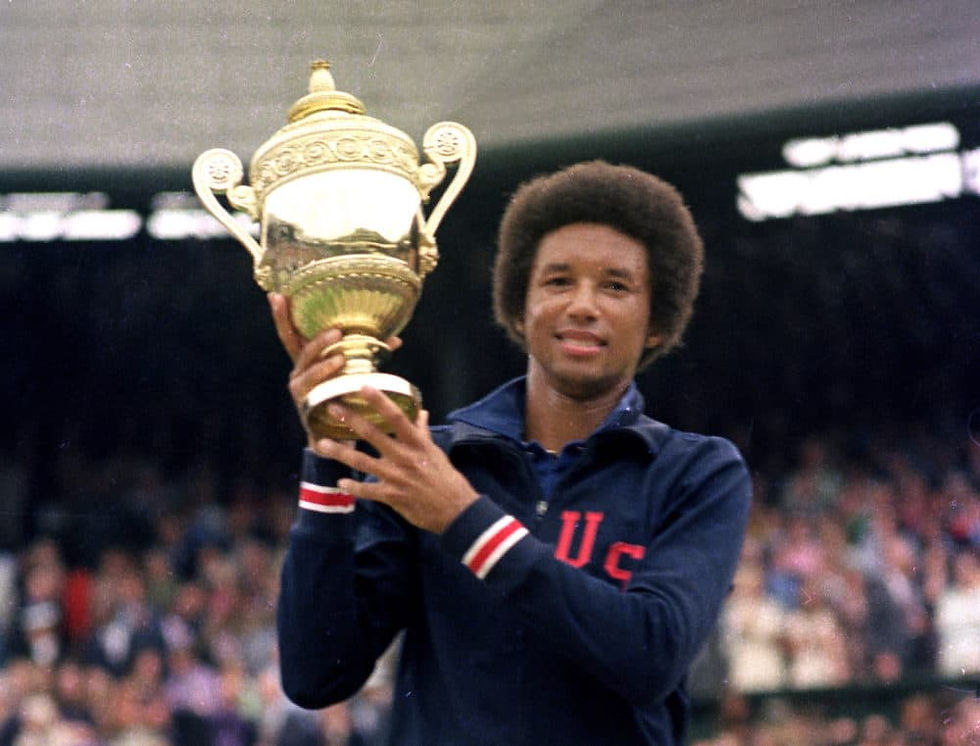
The Youth Charter's Tenniswise programme stands in that same tradition today, and its hope is a simple one: that the coaching, court time and belief it is putting into communities across Britain right now will, within a generation, produce homegrown Black players competing and winning on the Wimbledon Centre Court and Grand Slam finals stage in the numbers British tennis has never yet seen.
Whatever happens on Sunday, this week's semifinal is already a historic moment for the sport, and a fitting one to mark by rededicating Tenniswise to the values Arthur Ashe lived by:
That talent is everywhere, even when opportunity is not - and that the job of a good programme is to close that gap, not wait for it to close itself.
That sport is a platform for character as much as competition - discipline, resilience and grace under pressure, on the court and off it.
That access should never depend on background - every young person deserves a racket in their hand and a coach who believes in them, regardless of where they start.
That champions carry a responsibility to those coming behind them - exactly as Ashe did, and exactly as this week's finalists now have the chance to do for the next generation.
Fifty-four years after Arthur Ashe's last US Open final, Tenniswise commits to making sure the next barrier does not take another fifty-four years to fall.


Comments