

From the School Playground and Beyond the School Gate - A Whole Sport Plan for Hope, Opportunity and Community Transformation…


The final whistle at the FIFA World Cup reminded us of something that governments often forget - sport has the unique ability to unite a nation.

For a few extraordinary weeks, differences of geography, politics, ethnicity and circumstance disappeared. Young people wore the same colours, families celebrated together, communities gathered in parks, clubs and public spaces, and a shared national identity emerged through the simple power of play. The challenge for Britain's new Prime Minister is not how to recreate the World Cup, the challenge is how to recreate what it represented every single day in every school, every neighbourhood and every community.

The opportunity is greater than any sporting event. It is the opportunity to build a national movement that begins in the school playground, continues beyond the school gate and transforms communities through sport, arts, culture and physical activity.
Despite almost twenty years of changing governments, changing ministers and changing strategies, many of the same challenges remain. Physical activity in schools has declined, participation has reduced, facilities continue to disappear and opportunities remain unequal.
The consequences extend far beyond PE lessons. When young people become disconnected from education, when communities lose trusted youth provision, when playgrounds fall silent, when sports clubs disappear - the vacuum is quickly filled by something else - mental ill-health, physical inactivity, emotional isolation, social exclusion, anti-social behaviour county lines, gang affiliation, knife crime, violence, extremism.
These are not separate problems; they are different symptoms of the same failure to invest consistently in children and communities. For over thirty years the Youth Charter has argued that prevention costs less than intervention. Today that truth is impossible to ignore.

The School Gate Is Not the Finish Line. Too often policy ends when the school day finishes - young people do not. Life continues beyond the classroom. The transition from school to community is where many young people either flourish or fall through the gaps. This is why Britain needs more than a PE strategy. It needs a ‘Whole Sport Plan’ - one that connects early years, primary schools, secondary schools, colleges, universities, community organisations, sports clubs, arts organisations, health services, employers and families, all working together around the young person, not around institutions.
The Youth Charter Community Campus

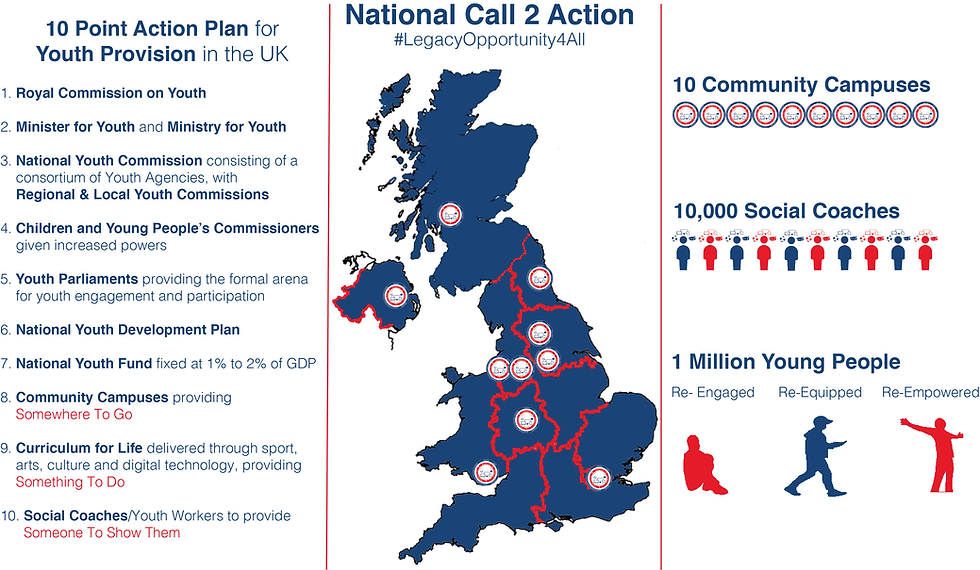
For over three decades the ‘Youth Charter’ has been developing exactly this model. The Community Campus is not simply another sports project. It is a place-based social infrastructure designed around three principles: Engage - Reaching young people before crisis, Equip - Developing confidence, skills, health and employability and Empower - Creating pathways into education, employment, entrepreneurship, volunteering and leadership.

The model links schools with community organisations, local authorities, employers, universities, sports governing bodies, health providers and cultural institutions to create seamless opportunities that continue beyond the school day. The playground becomes the starting point, the community becomes the classroom the future becomes achievable.
The national conversation has rightly focused on mental health, yet mental wellbeing cannot be separated from physical wellbeing - neither can be separated from belonging.

Young people who feel connected to their community are less likely to become disconnected from society. Sport creates: belonging, identity, purpose, discipline, teamwork, resilience, confidence and aspiration. Arts and culture provide expression. Education provides knowledge. Employment provides opportunity. Together they build hope and hope is perhaps the most powerful crime prevention strategy available.
The Prime Minister's Opportunity

You may note that the Prime Minister's earlier ministerial responsibilities for culture, media and sport, where many of the same policy issues remain unresolved nearly two decades later. That experience now presents an opportunity.

Throughout his political and ministerial journey and later through his leadership in Greater Manchester he has been familiar with the Youth Charter's work and the development of Community Campuses as a practical response to social inequality, youth disengagement and place-based regeneration.
Today, with responsibility for national leadership, there is an opportunity to move beyond individual initiatives towards a long-term strategy that connects education, sport, health, culture, employment and community development through a single, joined-up framework.

The Youth Charter's ‘National Call to Action’ proposes10 Community Campuses, 10,000 Social Coaches, 1 million young people directly engaged, 5 million indirect beneficiaries. This is not simply an investment in sport. It is an investment in education, health, safer communities, employment, social mobility, economic growth and national wellbeing.
Every pound invested in prevention has the potential to save many more in policing, criminal justice, health and welfare costs. The greatest legacy government can create is not another strategy, it is changing the trajectory of a child's life.

From Birmingham to Glasgow, the forthcoming Commonwealth Games in Glasgow provide another defining opportunity. The Youth Charter's Birmingham 2022 Legacy Pledge demonstrated that major sporting events can create lasting social value long after medals have been awarded.

Over the past four years this commitment has helped establish five of the proposed ten Community Campuses, creating local partnerships that continue to support young people beyond the event itself. Glasgow now has the opportunity to build upon that foundation.

Rather than viewing the Commonwealth Games as a two-week sporting festival, they should become the catalyst for a new generation of Community Campuses across Scotland and the wider Commonwealth. That would represent a legacy measured not in attendance figures, but in healthier communities, stronger local economies and brighter futures for young people.
From Inspiration to Transformation

The World Cup showed us what sport looks like when it unites a nation. What if every school, every park, every community centre and every sports club became part of one national movement? What if every child had somewhere safe to belong after school? What if every coach became a Social Coach? What if every community became a Community Campus? This is no longer simply about sport. It is about creating a social, cultural and economic win-win-win for young people, families and communities.
For more than thirty years, the Youth Charter has maintained that sport is not the end in itself - it is the beginning of something far greater. From the school playground, beyond the school gate and into every community. The time has come for a ‘Whole Sport Plan’ that places children and young people at the heart of national renewal. The Prime Minister has inherited a profound challenge - he also has an historic opportunity.
The Youth Charter's ‘Community Campus’ model and ‘National Call to Action’ provide a proven framework to turn hope into opportunity, opportunity into participation, and participation into lasting social change.
The World Cup united the nation for a month. A ‘Whole Sport Plan’ can unite communities for a generation.



Comments